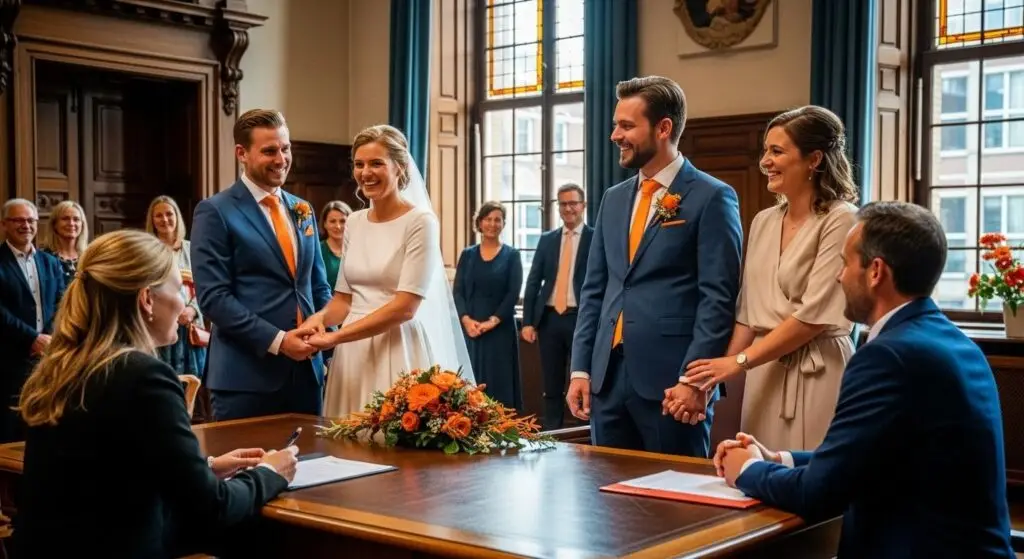
Marriage in the Netherlands is a civil status with concrete financial and legal consequences. Both partners must be at least 18, must not be too closely related and must marry before a registrar (ambtenaar van de burgerlijke stand); a religious ceremony has no civil effect and may not take place before the civil marriage. Same-sex couples have been able to marry on the same terms since 1 April 2001.
The most consequential rule is the property regime. For marriages concluded from 1 January 2018 the default is a limited community of property (beperkte gemeenschap van goederen): what each of you owned before the marriage, and what either receives by gift or inheritance, stays personal, while what you build up during the marriage is shared. Marriages concluded before that date fall under the old general community of property, unless you agreed prenuptial conditions. Below we set out the requirements, the property consequences and the rights and duties that follow.
Who can marry in the Netherlands?
You can marry here if you are both 18 or older, neither of you is already married or in a registered partnership, and at least one of you is a Dutch national or lives in the Netherlands. The rules are in Book 1 of the Dutch Civil Code (BW).
ما هي المتطلبات القانونية؟
- Age: both partners must be at least 18 (Article 1:31 BW). Since 2015 there is no exception for younger partners.
- Free consent: a marriage concluded under duress can be annulled, and forced marriage is a criminal offence.
- No existing marriage or registered partnership: bigamy is prohibited (Article 1:33 BW).
- No close family tie: parents and children, grandparents and grandchildren, and siblings may not marry each other (Article 1:41 BW). Siblings by adoption may need a dispensation from the Minister of Justice and Security.
- Nationality or residence: if both of you live abroad and neither is Dutch, you cannot marry in the Netherlands.
- Witnesses: at least two and at most four, each 18 or older.
A person placed under guardianship (curatele) needs the consent of the guardian or the subdistrict court (kantonrechter) to marry.
How does the procedure at the municipality work?
You first give notice of your intended marriage (melding voorgenomen huwelijk) to the municipality where you want to marry. Netherlands Worldwide advises doing so at least eight weeks before the wedding; the wedding must then take place within one year of the notice. If both of you live abroad, notice goes to the municipality of The Hague.
With the notice you submit your passports, birth certificates and, if you were married before, proof that the earlier marriage has ended. Foreign documents usually need an apostille or legalisation and a sworn translation. If the registrar suspects a sham marriage aimed only at obtaining residence, the municipality can involve the police and refuse to conduct the marriage.
The marriage itself takes place in the town hall or at another approved location, before a registrar and your witnesses. The registrar then records it in the register of marriages, which is the proof of your marriage.
What property regime applies to your marriage?
For marriages from 1 January 2018 a limited community of property applies by law (Article 1:94 BW). Earlier marriages fall under the general community, in which almost everything you both owned and owed became shared, including what you had before the marriage.
Under the limited community, pre-marital assets and debts stay personal. So do gifts and inheritances, during the marriage as well. A business you already owned stays yours. Whether part of its growth in value during the marriage falls into the community, because you work in it, is a frequent point of dispute at divorce.

When do you need prenuptial conditions?
If you want a different arrangement, you make prenuptial conditions (huwelijkse voorwaarden) in a notarial deed before a civil-law notary (Article 1:115 BW). You can make them before the marriage or change them during it. To bind third parties such as creditors, they must be entered in the public matrimonial property register (huwelijksgoederenregister) (Article 1:116 BW).
Prenuptial conditions are common where one of you runs a business, has significant assets or debts, or expects an inheritance. Many contain a settlement clause: a periodic one, under which you share savings from income every year, or a final one, which applies at divorce or death. A periodic clause that you never carried out can still lead to a division as if a community existed, so follow what you agreed.
What if you married abroad or have different nationalities?
For international couples who married on or after 29 January 2019, the applicable matrimonial property law follows from Regulation (EU) 2016/1103. In principle you can choose the law of the country where one of you lives or of which one of you is a national. Without a choice, the law of your first common habitual residence after the marriage usually applies. For earlier marriages, older conflict rules apply, such as the 1978 Hague Matrimonial Property Convention.
What rights and duties do spouses have?
Spouses owe each other fidelity, help and support, and must provide each other with what is necessary (Article 1:81 BW). Both contribute to the costs of the household in proportion to their income and assets (Article 1:84 BW).
Are you liable for your spouse’s debts?
For debts entered into for the normal running of the household, both spouses are jointly and severally liable, whoever signed (Article 1:85 BW). Under a community of property, a creditor of one spouse can also recover common assets, including the family home.
Which transactions need your spouse’s consent?
Under Article 1:88 BW you need your spouse’s written consent to sell or rent out the family home, to make gifts beyond the usual, to stand surety and to buy on instalment credit. Without that consent, your spouse can annul the transaction, usually within three years.
What happens on divorce or death?
On divorce, a spouse without sufficient income can claim spousal maintenance, for at most five years in most cases (Article 1:157 BW). Pension built up during the marriage is in principle divided equally. On death, the surviving spouse is a statutory heir together with the children; under the statutory division (wettelijke verdeling, Article 4:13 BW) the spouse receives all assets and the children receive a claim payable on the spouse’s death.

How does marriage compare with a registered partnership or cohabitation?
A registered partnership (geregistreerd partnerschap) has almost the same legal consequences as marriage, including the property regime, maintenance and inheritance. The main difference is that you can end a partnership without a court if you have no minor children and agree on everything.
Cohabiting without marriage or partnership gives you few automatic rights. You are not each other’s statutory heir, and there is no statutory maintenance duty between you. A cohabitation agreement (samenlevingsovereenkomst), preferably notarial, and a will are then needed to protect each other. Marriage and partnership abroad may be treated differently, so check how the other country recognises your status.
What should you check before you marry?
The choices you make before the wedding decide what happens to your assets for years afterwards. Check:
- Whether at least one of you is Dutch or lives in the Netherlands, and when you must give notice to the municipality.
- Whether your foreign birth certificates and divorce decrees carry an apostille or legalisation and a sworn translation.
- Which assets, debts, businesses or expected inheritances each of you brings in, and whether the limited community suits you.
- Whether you want prenuptial conditions, and whether they are registered in the matrimonial property register.
- For international couples, which country’s law governs your property under Regulation (EU) 2016/1103, and whether to make a choice of law.
- Whether your wills and pension beneficiary arrangements still match your plans.
What can we do for you with marriage law?
محامي الأسرة advise Dutch and international couples before, during and after marriage. In practice we:
- Assess whether you can marry in the Netherlands and which documents the municipality will ask for.
- Explain the effect of the limited community of property on your assets, business and debts.
- Advise on the content of prenuptial conditions and review the notary’s draft before you sign.
- Determine which law governs your matrimonial property in a cross-border marriage.
- Assess whether a transaction by your spouse needed your consent under Article 1:88 BW, and annul it if necessary.
ملخص
- You can marry in the Netherlands if you are both 18 or older, unmarried, not closely related, and at least one of you is Dutch or lives here.
- Since 1 January 2018 a limited community of property applies by default; pre-marital assets, gifts and inheritances stay personal.
- Prenuptial conditions require a notarial deed and registration in the matrimonial property register to bind third parties.
- Spouses are jointly liable for household debts and need each other’s consent for major transactions such as selling the family home.
الأسئلة المتكررة
ما هي المتطلبات القانونية للزواج في هولندا؟
Both partners must be at least 18, neither may be married or in a registered partnership, you may not be closely related, and at least one of you must be a Dutch national or live in the Netherlands. You need two to four witnesses aged 18 or older.
Which property regime applies if we marry without prenuptial conditions?
For marriages from 1 January 2018 the limited community of property applies (Article 1:94 of the Dutch Civil Code). What you build up during the marriage is shared; pre-marital assets, gifts and inheritances stay personal. Marriages before 2018 fall under the general community of property.
Can we make prenuptial conditions after the wedding?
Yes. You can make or change prenuptial conditions during the marriage in a notarial deed. They bind third parties only after registration in the public matrimonial property register.
Is a religious wedding legally valid in the Netherlands?
No. Only a civil marriage before a registrar has legal effect. A religious ceremony may only take place after the civil marriage.